Recap:
- Shutters offer adjustable louvers for privacy and daylight control while adding a finished look to a home’s exterior and resale appeal.
- Material choice, mounting, and maintenance affect how well shutters perform in hot, sun-intensive climates like Scottsdale, AZ.
- Comparing shutters against blinds and shades helps homeowners match a window treatment to their specific privacy, light, and durability needs.
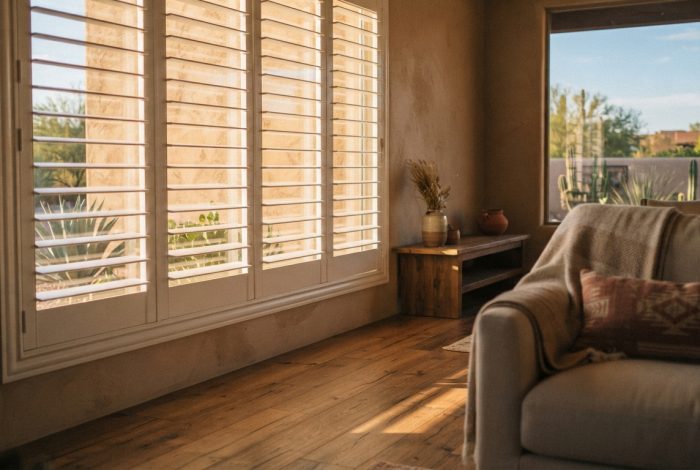
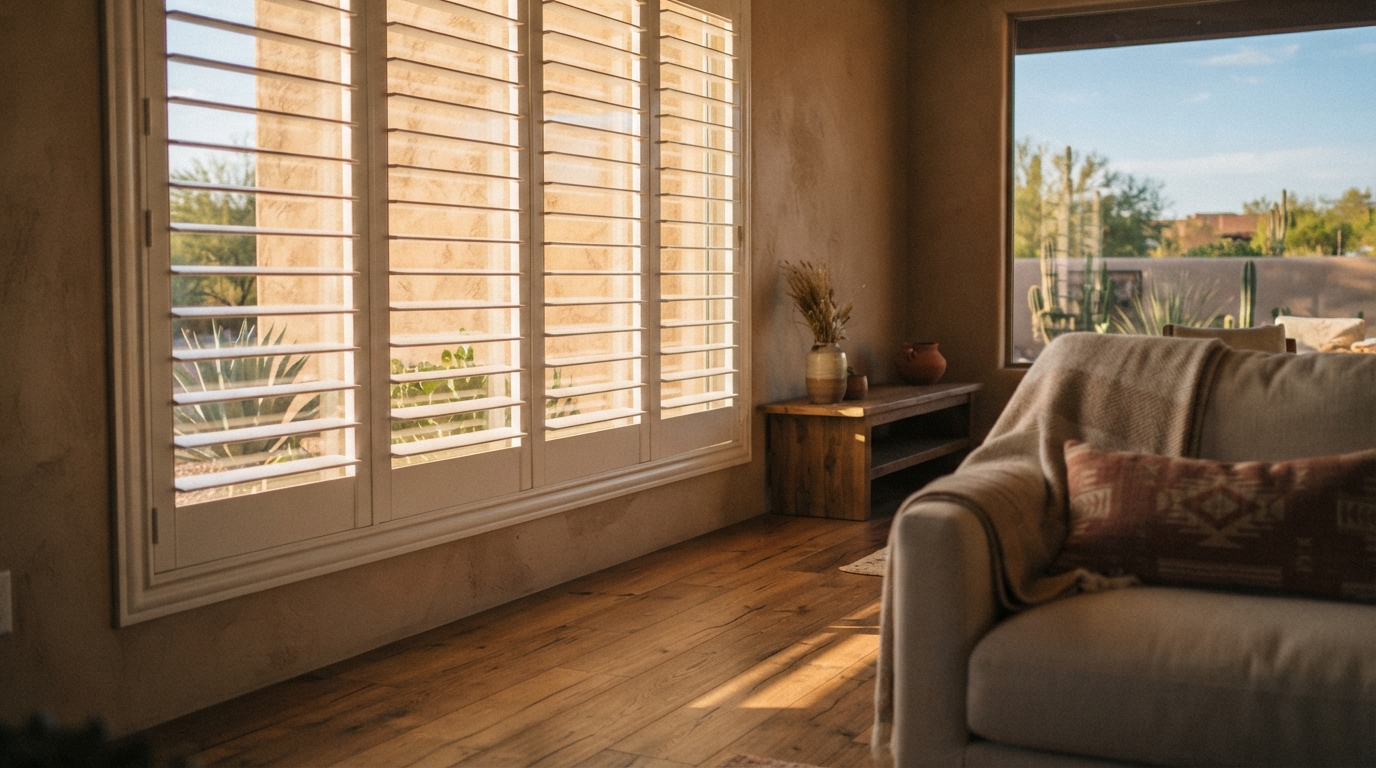
Shutters are a solid-panel window covering with adjustable louvers that let homeowners control privacy and daylight independently, room by room. Unlike fabric shades or slatted blinds, they mount directly into the window frame and remain a permanent architectural feature rather than a removable accessory.
For homeowners comparing window treatments, Shutters stand out because their rigid construction blocks sightlines completely when closed while still allowing airflow and filtered light when louvers are angled open. This dual function makes them a common choice in homes where both street-facing privacy and consistent natural light matter throughout the day.
How Shutter Louvers Control Privacy and Light
The core function of any shutter is the louver, a movable slat that tilts to redirect light without fully exposing the interior of a room.
- Closed flat: blocks nearly all outside view and most direct sunlight, useful for bedrooms or street-facing rooms.
- Angled upward or downward: diffuses daylight across the ceiling or floor while maintaining privacy from eye level.
- Fully open: maximizes natural light and outdoor views when privacy is not a concern.
This adjustability is one reason shutters are often rated differently from fixed window films or sheer curtains, which cannot adapt to changing light conditions during the day.
Light Control and Energy Considerations for Scottsdale, AZ Homes
Homes in Scottsdale, AZ face long stretches of direct, high-intensity sun, which makes window covering choice relevant to both comfort and cooling costs. The U.S. Department of Energy notes that operable window coverings give homeowners the flexibility to choose whether to keep coverings open or closed for privacy, and to maximize natural light, take advantage of heat from the sun in the winter, and reduce heat gain in the summer.
Because shutters are rigid and close with a tighter seal than many fabric treatments, closing them during peak sun hours can help reduce the amount of solar heat entering a room. The same Energy Saver guidance points out that most window coverings are operable, yet 75% of residential window coverings remain in the same position every day, according to a U.S. Department of Energy study — meaning the efficiency benefit depends on actually adjusting them with the seasons rather than leaving them static.
Shutters Compared to Blinds and Shades
Homeowners weighing shutters against other window treatments often focus on three factors: light control precision, durability, and long-term maintenance.
| Feature | Shutters | Blinds | Shades |
| Privacy when closed | Solid, near-complete block | Moderate, gaps between slats | High, but no light filtering option |
| Light adjustability | Precise, via tilting louvers | Moderate | Limited to raise/lower |
| Typical lifespan | Long, rigid frame construction | Moderate | Shorter, fabric wears faster |
| Exterior curb appeal | Adds architectural detail | Minimal exterior visibility | Minimal exterior visibility |
Shutters generally require less frequent replacement than fabric shades because the frame and louvers are built from more rigid materials, though upfront cost is typically higher than blinds or basic shades.
Curb Appeal and Installation Considerations
From the street, closed shutters read as a finished architectural detail rather than a makeshift covering, which is part of why they are frequently highlighted in real estate listings. A few practical points matter before installation:
- Window frame depth determines whether interior-mount shutters will fit without extensions.
- Louver size (smaller louvers read more traditional, larger louvers suit contemporary exteriors).
- Material selection affects how shutters hold up against heat and UV exposure over time, which is a relevant factor for homes exposed to intense year-round sun.
A professional measurement is typically recommended before ordering, since window frames in older homes are not always perfectly square.
Frequently Asked Questions
Do shutters block more light than blinds when fully closed? Solid-panel shutters generally create a tighter seal than slatted blinds, which can leave small gaps between slats even when closed.
Can shutter louvers be adjusted for partial privacy? Yes. Louvers tilt to multiple angles, allowing homeowners to let in filtered light while keeping the interior shielded from direct outside view.
Are shutters a permanent window treatment? Shutters are typically frame-mounted and considered a fixed architectural feature, unlike blinds or shades, which can be removed without altering the window frame.
Do shutters need special care in hot climates? Material choice matters; some materials handle prolonged heat and sun exposure better than others, so checking manufacturer specifications for a given climate is a reasonable step before purchase.
Business Information
Based in Tempe, AZ, Arizona Shutter Company serves customers across Scottsdale, AZ.
Readers can Schedule Free Consulation for published location and contact details.